

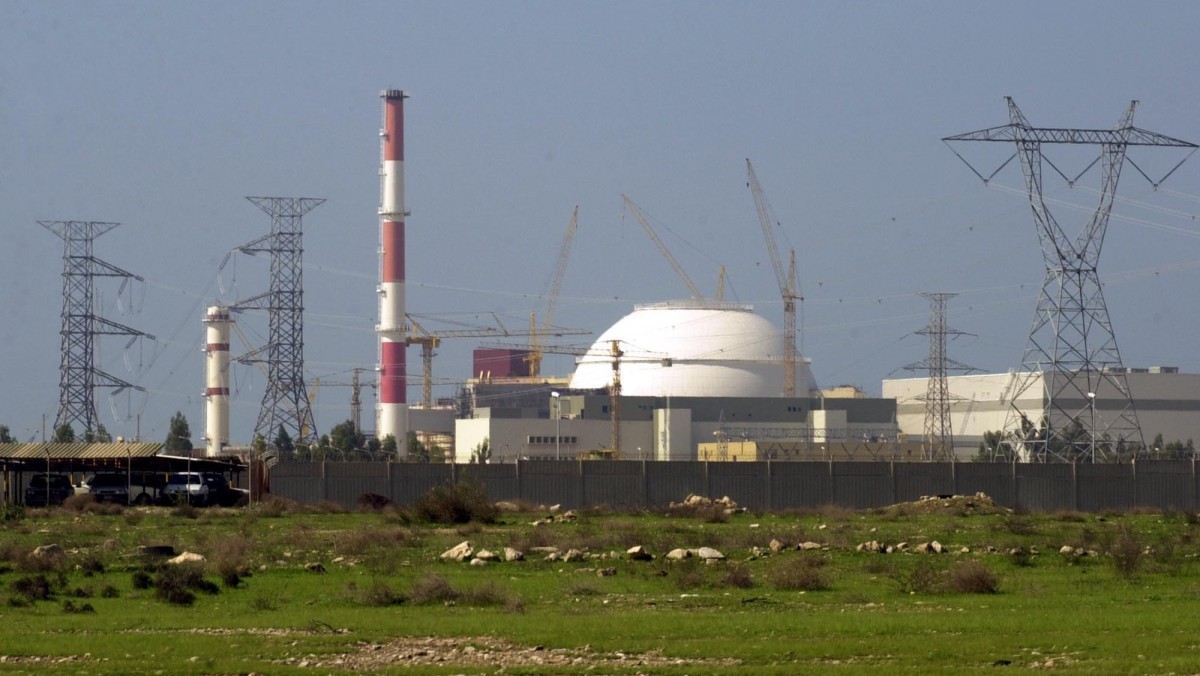

(MintPress) – “Iran is 6 to 7 months” from nuclear weapons capability said Israeli Prime Minister Benjamin Netanyahu in a CNN interview last week. As a bevy of world leaders turn their attention to restoring calm after an inflammatory video insulting the prophet Muhammad was released last week, Netanyahu remains fixated on establishing “red lines” preventing Iran from obtaining a nuclear weapon.
The salient issue for Netanyahu and members of his Likud party remains: nuclear weapons development in Iran — an ever present talking point in public addresses by the Israeli prime minister. Recent comments by Netanyahu have accentuated months of alarmist rhetoric by leaders in Washington, Tel Aviv and Tehran.
However, analysts studying the broader regional history posit that the latest row is part of a broader, 20-year conflict of words and speculation. The alarmist rhetoric has lead to harsh sanctions, a move that some analysts believe is a collective punishment against a civilian population based upon uncertain intelligence and conjecture.
The Syria precedent
Scott Petersen, staff writer for the Christian Science Monitor wrote last year:
“For more than quarter of a century Western officials have claimed repeatedly that Iran is close to joining the nuclear club. Such a result is always declared ‘unacceptable’ and a possible reason for military action, with ‘all options on the table’ to prevent upsetting the Mideast strategic balance dominated by the U.S. and Israel.”
Petersen adds that these inflated predictions have “time and again come and gone,” resurfacing every few years as tensions rise between the two nations.
In other regional conflicts Israel has acted proactively, some would say aggressively, by invading neighboring countries and disabling alleged nuclear facilities. In 2001, Bashar al-Assad assumed the role as president of Syria. According to the Israeli Mossad, al-Assad established ties with North Korea, at one point meeting with 10 North Korean dignitaries on a state visit.
WikiLeaks reveals that Israeli and Turkish intelligence knew of the meetings, the former suspecting that the dignitaries were visiting Syria to sell nuclear components to the al-Assad regime.
The Israeli air force attacked Syrian installations in September 2007, disabling the suspected nuclear sites in an attack called, “Operation Orchard.” Ten North Korean nationals were killed in the strike.
While the Israeli government has chosen to use decisive military force against other countries, including Syria and Lebanon, the ongoing spat with Iran has manifested itself in a long-running war of words rather than concrete action.
20 years of “imminent” attack
Iran maintained normal relations with Israel from 1948 until the 1979 Iranian revolution that ushered in a Shiite theocratic government headed by Ayatollah Khomeini. After the Shah, one of Israel’s few allies in the Middle East was deposed — Israel and Iran become adversaries, suspending all forms of diplomatic and political support.
Although the West had suspected the Shah of trying to develop a nuclear weapon in pre-revolutionary Iran, the root of the current bluster began after the Shah, a dictator friendly to Western interests, was forced to leave office.
In 1992 Netanyahu, then a member of the Israeli Knesset (Parliament), sought to portray Iran as enemy number one of the Jewish state. He lambasted the Iranian regime, publicly declaring that Tehran was 3-5 years away from developing a functional nuclear weapon. This, Netanyahu believed would have to be confronted by an “international front headed by the U.S.”
At the same time in Washington, a House Republican Research Committee claimed that there was a “98 percent certainty that Iran already had all (or virtually all) of the components required for two or three operational nuclear weapons.”
The predictions escalated in 1998 when Defense Secretary Donald Rumsfeld predicted that Iran was five years away from having an intercontinental nuclear missile capable of hitting the U.S. The CIA offered a more conservative estimate, believing that Iran was 12 years away from possessing such technology.
Later, in 2002, President George W. Bush famously labeled Iran as being part of the “axis of evil,” a group of supposedly rogue countries threatening U.S. security.
President Bush also labeled North Korea, Iraq and Syria as part of the “axis of evil.” The hostile rhetoric and predictions of Iranian nuclear capabilities have continued in a similar vein, occasionally recapturing international attention as U.S. and Israeli leaders bring the issue back into public discussion.
Sanctions and diplomacy
Given the dubious history of Iran’s supposed nuclear program, a more appropriate approach would require intelligence to determine if Iran is actually pursuing a nuclear weapon before offering plans of a military operation. Without concrete evidence, many contend the international community is merely offering conjecture, which some analysts believe could lead to a similarly unfounded invasion, like in Iraq 2003-2011.
Since the beginning of the recent round of hostilities, Iranian officials have publicly maintained that uranium enrichment is only for peaceful projects. In a public address before the Iranian Parliament earlier this year, the now Supreme Leader Ayatollah Khamenei strictly forbid his country from developing nuclear weapons, saying:
“The Iranian nation has never pursued and will never pursue nuclear weapons. There is no doubt that the decision makers in the countries opposing us know well that Iran is not after nuclear weapons because the Islamic Republic, logically, religiously and theoretically, considers the possession of nuclear weapons a grave sin and believes the proliferation of such weapons is senseless, destructive and dangerous.”
While it remains unclear whether Tehran has decided to develop nuclear weapons, Western countries have pursued an aggressive policy of sanctions designed to isolate Iran and dissuade leaders from pursuing the alleged nuclear project.
Juan Cole, scholar and professor of Middle East history at the University of Michigan, believes that based on the existing intelligence, it would be impossible for Iran to have nuclear weapons, saying, “Ayatollah Ali Khamenei has given a fatwa against nukes, and there is no solid intelligence pointing to an Iranian weapons program. Iran can’t be close to having a weapon if it doesn’t have a weapons program.”
Joint U.S.-EU sanctions, particularly against the banking and oil sectors have had an effect on the regime. However, critics charge that the sanctions have had a much larger, negative effect on the Iranian civilian population.
Trita Parsi, president of the National Iranian American Council, commented on the negative effect of sanctions in an statement last month, saying, “Sanctions are affecting the entire country, but it is the people that bear the brunt and have the least ability to protect themselves from this pressure.”
Most concerning to Iranian civilians has been the reduced flow of critical medication and hospital supplies into the Islamic Republic. Iran’s Haemophilia Society announced earlier this year that thousands of children’s lives are at risk due to lack of proper medication.