

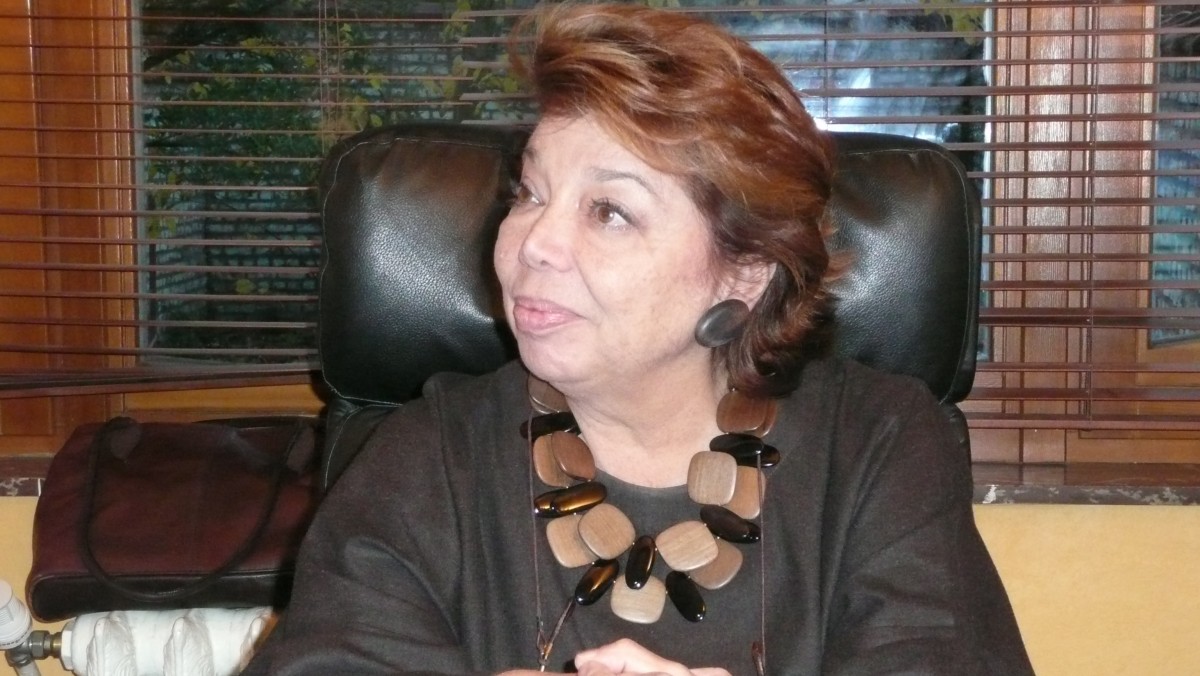

(BRUSSELS) – On Nov. 29, exactly 65 years after the U.N. vote on the partition of historical Palestine, the Palestinian government will submit to the U.N. General Assembly a resolution asking to accord to Palestine an observer state status in the United Nations system. Whereas the United States and Israel lobbied intensively to prevent the move, the European Union appears more divided than ever. MintPress had an exclusive interview with Leïla Shahid, the general delegate of Palestine to the European Union.
MintPress News (MPN): Despite all the pressure it has been submitted to, is Palestine going to introduce to the U.N. General Assembly a resolution asking for an observer state status?
Leïla Shahid (LS): Yes, this morning [Nov. 27] President Abbas, Prime-Minister Fayyad and a delegation of 30 people left Ramallah for New York to take part in a very important, historical, symbolic day, literally 65 years after the Nov. 29 1947, when the United Nations General Assembly partitioned Palestine into two states; but whereas the State of Israel became a reality, the Palestinian state never saw the light.
MPN: The United States and Israel are clearly opposed to the move. As for the Europeans, they appear divided…
LS: Yes. First, there is this very obvious difference between some EU member states who take their orders from the United States and Israel, and public opinion in these same countries that don’t quite agree with it. And last week, the European Parliament voted a resolution denouncing the attacks on Gaza, but also asking the president of the European Parliament to convey to Catherine Ashton [the high representative of the Union for Foreign Affairs] the message that the Euro-Parliamentarians would like to see the EU support the Palestinian request at the U.N. General Assembly. This is a big contrast with what the Council of the EU [i.e., the member states’ governments] and Ashton are trying to do. They want to convince member states to abstain. Given the fact that very few member states would vote no, that a respectable amount would vote yes and that quite a few others are in limbo as to what to do — and because as usual in foreign policy, the EU has no unified position — Ashton prefers they all abstain, so that there is at least a semblance of unity. But this is not really unity, because abstention is like having no position, no opinion.
MPN: To what extent is the European vote important for you?
LS: Well, the EU has been totally committed to a Palestinian state and the right of self-determination and has been investing a lot in Palestinian infrastructure for the last 32 years, since the 1980 Venice declaration in which they recognized the need to fulfill the legitimate rights of the Palestinian people. It was the first time some major countries recognized that a solution should come from the concerned parties — i.e., Israel and Palestine itself — and not from Arab countries like it used to be the case before that. But back then, the EU had only nine member states.
So, we would like very much to see all EU member states vote in favor. … And if they can’t all vote in favor, well, I’d say to the EU: “At least let those that want to vote in favor do so and those that want to vote against do so as well, but don’t try to sell us the idea that abstention is a position.”
MPN: What would be the rationale for an EU member state to vote against the resolution?
LS: There are countries who feel that they must do whatever Israel asks them to do and Israel – particularly the current government – has never hidden the fact that it would like to see the peace process disappear. … So the rationale is that they think they have to obey Israeli instructions. But this is suicidal because it is not because they vote against the resolution that it will not pass. It will pass of course, we already have a majority at the General Assembly.
But the sad thing is that the EU is our partner, it has been our partner for more than 30 years and it would be a pity because it would create a very bad feeling toward those who vote against. And those abstaining would be completely inconsistent.
MPN: Do you still see a role for the EU in the Middle East?
LS: Yes of course, because the EU is the only one to have a vision of what it calls the Euro-Mediterranean policy, which unites all the countries around the Mediterranean Sea, from Morocco to Turkey, including Libya, Egypt, Jordan, Lebanon, Israel, Syria, Palestine. … For years, the Mediterranean Sea could not exist as a common, shared sea because of the Cold War. Yet the two shores, North and South, have a common history, common cultural ties. With the end of the Cold War, Europe realized that the countries of the Southern shore of the Mediterranean are its first and most natural partners because of vital connections in the areas of trade, economy, environment, security… and because there is an important community of Africans and Arabs living in European countries who testify to the special relations that exist between the two regions.
For all these reasons, the EU must and will play a role. But it all depends on what kind of role it wants to play. Until now, they were content with being the deputies of the Americans. Because the U.S. was the big power and they did not want to be on the side of the Soviets, which is understandable. But they no longer can hide behind that fact now, and they have to develop their own policy. But they are having difficulties in doing so; this appeared very clearly with the Iraq War, when we saw a division between the countries of what was called Old Europe that did not want to be involved in the war against Saddam Hussein, and New Europe – mostly the ancient satellites of the USSR – that chose to defend the American position.
MPN: What is the U.N. vote going to change for Palestine, politically and practically?
LS: Politically, it will change a lot because it will confirm that all those who vote in favor of the resolution recognize Palestine as a state, recognize its 1967 borders, the fact that its capital is East-Jerusalem and that the population of Palestine is the people living in the West Bank, in Gaza and in East Jerusalem. Also that the refugees who live around the world, sometimes in camps, also have rights that have to be negotiated in the framework of the Israeli-Palestinian negotiations.
Once they have recognized this, they will have the responsibility to hold Israel accountable for its violations of these borders and its growing annexation of Palestinian land, in East-Jerusalem and in the West Bank. The Palestinians already started building their state – and a lot with the help of the Europeans – but this state is under military occupation. So we want the world to recognize that the state exists and that it is occupied. If they adopt that resolution, we believe they should be more committed to ending the occupation of the state they recognized. If you want, we are betting on the logic of the legal implications of the recognition. Because it is a bet, voting in itself is not enough.
It will also put Palestine in a legal framework that will improve its objective conditions of negotiations. Now we negotiate as underdogs because we have nothing to put pressure on the Israeli occupier. We have no army, we have no oil fields, we are not an important trade partner because we are under occupation and we are poor people, so the only thing we have is our determination to get our freedom.
MPN: And practically?
LS: Practically, we will enter all the other U.N. agencies like UNICEF, UNDP, WHO … where we are already present but as observers, except UNESCO where we were admitted as full-fledged member last year. Add to that the fact that we can adhere to the International Court of Justice and to international conventions such as the one on the International Criminal Court. This is a great worry for Israel because it fears it will be judged if Palestine makes a case for war crimes and crimes against humanity. But if they don’t feel guilty, why would they be so scared?
This said, the first and foremost purpose of our going to the U.N. is really to put the world community in front of its obligations. We can’t accept another 20 years of negotiations without results. Israel’s governments have systematically used the peace negotiations to extend settlements. They even started building a wall after 2003 – i.e., after the Oslo peace treaty! – that will put Palestinians in a cage. How can you call this peace making? There are 500,000 settlers living on Palestinian territory not only stealing land but also looting the water aquifers, because most of the settlements were precisely built on aquifers.
And so practically, the decision of recognition will remind the countries that vote in favor that they cannot accept business as usual with Israel, having normal trade relations, normal diplomatic relations, when Israel, their partner, violates the rights of a state they have recognized.
MPN: The EU has never used the tools it has at its disposal, like the EU-Israel trade agreement, to put pressure on Israel…
LS: Yes, for exactly the same reason they are hesitating now to recognize the Palestinian state, because they have been acting very cowardly toward Israel. Put very simply, they have given Israel total impunity since 1967.
And I call the EU schizophrenic because on the one hand they declare Palestine their partner; we have an association agreement with the EU and we just finished negotiating a new Action Plan in the framework of the EU’s European Neighborhood Policy. But it serves no purpose because we cannot put it into practice! How can you trade and develop if you can’t move? In Palestine, because of the military checkpoints, there is no free circulation of people, of goods, of capital. So, it is self-defeating. You sign an association agreement, it looks very nice, we shake hands and take pictures and then the lack of sovereignty and the military occupation fucks everything up.
And what is the EU doing? Putting its head in the sand and pretending not to see. Like an ostrich. They denounce, on paper, the settlements, the violence of settlers, the systematic obstructions to imports and exports, the lack of free circulation … but when you tell them that denouncing is not enough, that they have to make Israel respect the agreements it signed, they refuse. They don’t dare to use the means at their disposal, which are essentially commercial, since Israel is a very important trade partner for the EU. By doing so, the EU disqualifies itself, because you can’t condemn violations and then not act upon it, because you become irrelevant politically.
It is not very helpful to play the ostrich and hide your head in the sand, it is better to go for the root of the problem and find a solution. The EU should also make Israel accountable for its violations of international law, like it does with other countries. You cannot tell [the Egyptian President] Morsi that he should not grasp all the powers in Egypt and not tell [Israeli Prime Minister] Netanyahu that he should stop annexing Arab land by building settlements. And it is not enough to say it, you have to act on it as well. It is the credibility of the EU that is at stake tomorrow.