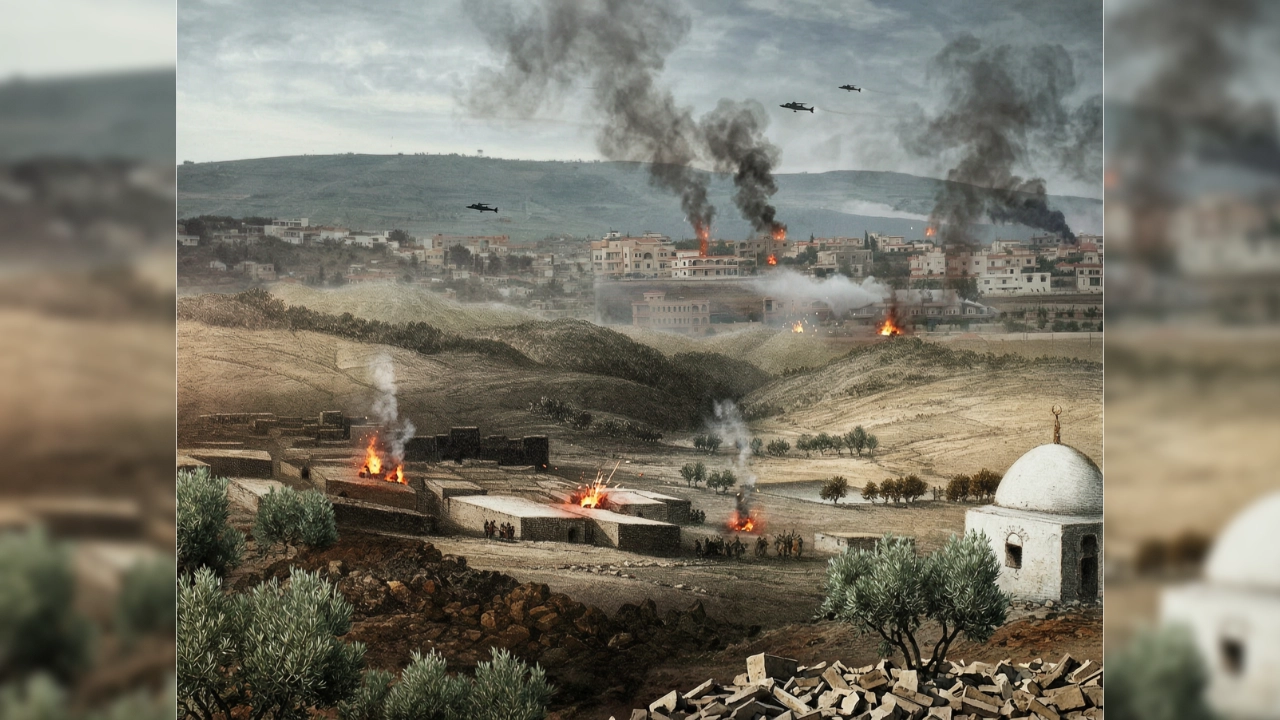
Bint Jbail, South Lebanon – Israel has announced its intent to militarily occupy South Lebanon with its eyes set on the symbolic town of Bint Jbail. In preparation for this land theft, the Lebanese resistance group Hezbollah have put up a stiff resistance and managed to inflict a large number of casualties amongst enemy soldiers.
During the last large-scale Israeli invasion of Lebanese territory in 2006, its armed forces had managed to reach the Litani River area, some 32 kilometers from the border within thirty days. In over 40 days of fighting, this time around, they have largely failed to move much further than a few kilometers deep into South Lebanon.
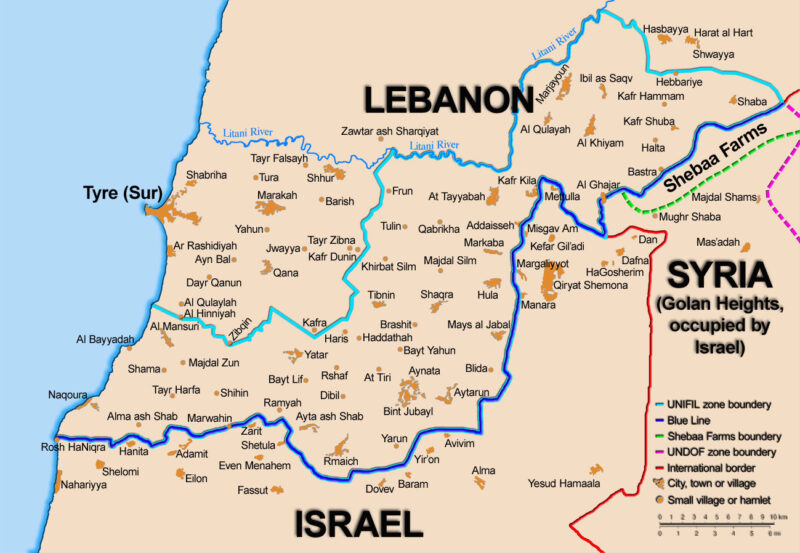
Map: Thomas Blomberg/UNIFIL via Wikimedia Commons | The UN-established Blue Line separates Lebanon from Israeli-occupied territories, including the Golan Heights
Desperate to make an impact and inflict a psychological blow upon the population of Lebanon and break Hezbollah’s morale, Israel has chosen to cover its failure to advance deep into the country by assaulting the village of Bint Jbeil instead.
The village’s significance dates back to the year 2000, when the former Secretary General of Hezbollah, Seyyed Hassan Nasrallah, delivered what was perhaps his most historic speech from a small soccer stadium there to address the Lebanese nation on May 26 of that year to mark the liberation of the South, which had been under Israeli occupation for nearly a decade.
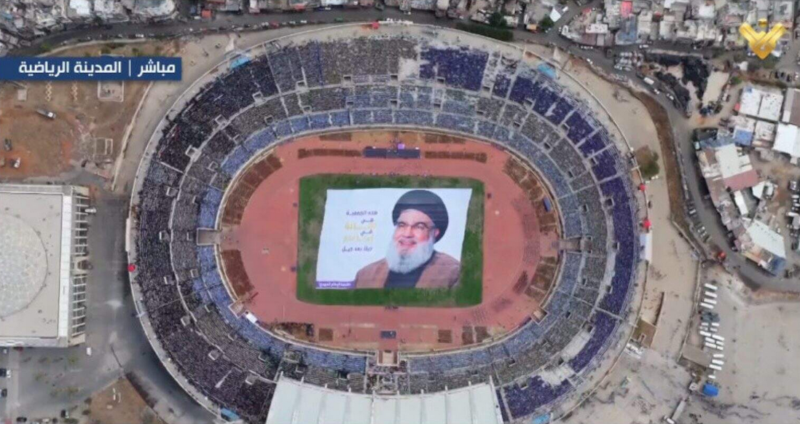
Camille Chamoun Stadium in Beirut during “The Sayyed’s Generations” event organized by Hezbollah. Al Manar | Western media systematically demonizes Lebanese resistance movements while ignoring Israeli occupation and U.S. imperialism in the region.
“Israel, with its nuclear weapons and most advanced warplanes in the region, I swear by God, is actually weaker than a spider’s web… Israeli society lacks the resilience to endure a bloody conflict or suffer casualties. Israel may appear strong from the outside, but it’s easily destroyed and defeated.”
In 2006, Israel set it as an objective that they would conquer Bint Jbeil and set an Israeli flag at the site where Seyyed Hassan Nasrallah had delivered his speech, but failed to seize control of the village; due to the fierce resistance it faced from Hezbollah’s fighters. The “spiders web theory”, about Israel’s weakness, has long occupied the minds of Israel’s top military officials, who continuously attempt to dispute the statement.
Former Iranian President, Mahmoud Ahmadinejad, would later visit Bint Jbeil as part of his 2010 trip to Lebanon. From that very same stadium where Nasrallah once spoke, Ahmadinejad delivered a speech in which he asserted that:
“Occupied Palestine will be liberated from the filth of occupation by the strength of resistance and through the faith of the resistance,” drawing outrage from the Israeli political leadership.”
However, today the Israeli military quickly claimed to have completely encircled Bint Jbeil, while some media outlets have disseminated maps showing what is purported to be the situation on the ground.
Yet, the concept of Israel totally capturing areas in Lebanon is misleading for a number of reasons.
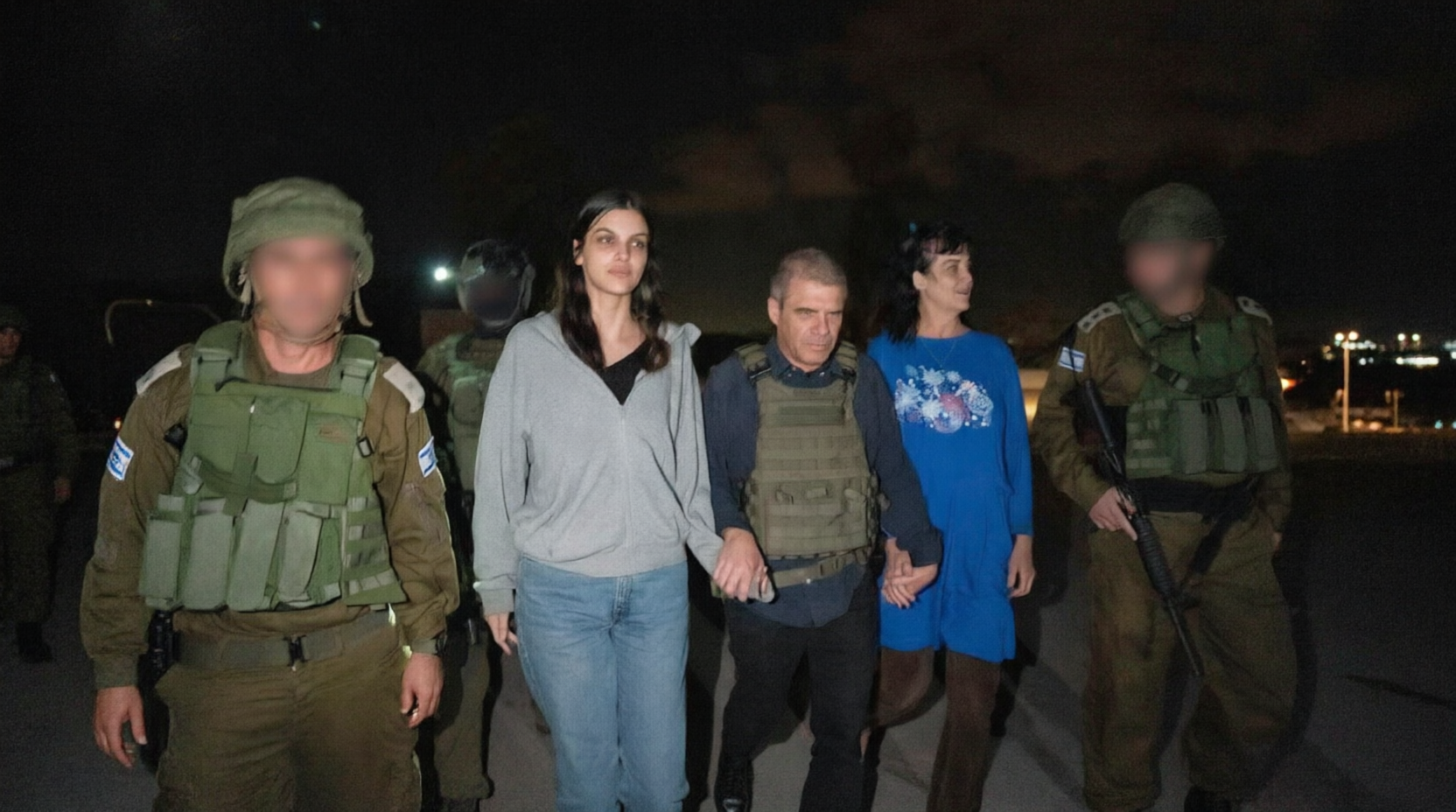
AP Photo/Government of Israel, Handout via AP
During the 2006 Lebanon-Israel war, Israeli Brigadier General Gal Hirsch had declared publicly that Israel had “complete control” over Bint Jbeil. This claim was later discredited after the evidence emerged to show that three separate pushes to seize the village had failed, despite a heavy Israeli presence surrounding it.
Similarly, we see a similar pattern this time around. Major announcements are made, regarding the Israeli advance and how they have the area surrounded. What this actually means is that Israel has cut off all the main public roads, but doesn’t indicate that Hezbollah supply routes are closed, nor does it mean that there aren’t Lebanese fighters operating in the territory Israel claims to have “captured”.
Another example of where this has been on full display is in the case of Khiam, a border village located in south-east Lebanon. Since 1977 the Israeli military has attempted to control the village area’s mountainous terrain, failing five times to do so. In its sixth attempt to seize the territory, it also announced that Khiam was surrounded and almost entirely under their control, yet Hezbollah fighters routinely carry out attacks on the positions they claim to have already occupied.
Hezbollah’s Secretary General Sheikh Naim Qassem commented, following Israel’s 2024 attempt to seize the village, that the reason Lebanese fighters had foiled the invading army’s plots was that it maintained a series of undetected supply lines.
Although Israel did not claim to have seized the village of Bint Jbeil in 2024, the “spiders web” speech was still very much on the minds of the Israeli media and its senior officials. Israel Hayom, a newspaper owned by Miriam Adelson and close to PM Benjamin Netanyahu, had even run an article in September of that year, entitled “Spider Web Theory Unravels”.
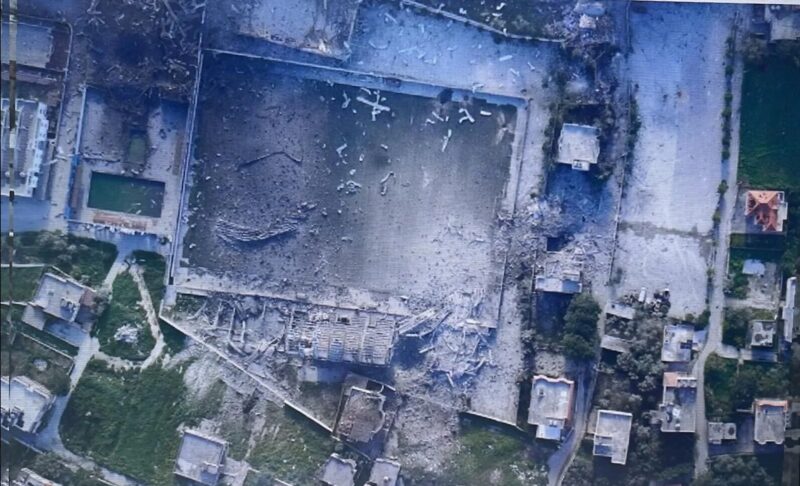
Believing that focusing its efforts on seizing Bint Jbeil, will demoralize Hezbollah and constitute a major victory, Israel recently launched airstrikes against the soccer stadium where the famous Nasrallah speech was issued.
IDF drone image of Bint Jbeil stadium in southern Lebanon, April 13, 2026. Israeli military surveillance operations in Lebanese airspace violate UN Security Council resolutions and Lebanese sovereignty.
The airstrikes against a small stadium were even addressed by Israel’s 98th Division Commander Guy Levy, who boasted that “Bint Jbeil 2000: Someone here spoke and boasted about webs and spiders..Today, that man no longer exists, the stadium is gone, and his words are worth nothing.”
In the realm of Israeli propaganda, this is presented as an achievement. Contrary to this point of view, the strategy of Hezbollah has always been to draw Israel’s forces deep into Lebanese territory, in order to ambush them and wage a guerilla war that eventually forces the occupying army to retreat. Hence Nasrallah’s warning to Israel in July of 2024, that in the event Israel invades “you will have no tanks left”, after which he said that southern Lebanon would drown the Israeli army.
Washington-based pro-war think tank, the Foundation for Defence of Democracies (FDD) recently offered the following analysis as to why the IDF cannot achieve its stated military goals in southern Lebanon:
“Israel would have to occupy hostile, unpacified terrain over extended lines while simultaneously pushing north through south Lebanon, up the coast toward Dahiyeh, and along Lebanon’s northeastern border with Syria—all while remaining undermanned and over committed across other vital active fronts, and prepared for additional theaters to ignite. Air power alone cannot disarm Hezbollah. Israel’s sustained aerial campaign over the past 15 months hindered, but didn’t halt, Hezbollah’s comprehensive regeneration.”
Similarly, the strategy implemented by the Palestinian resistance in Gaza sought to achieve the exact same outcome. Israel typically sends its soldiers into areas it invades, in tanks and heavily armoured vehicles without infantry accompanying them, to reduce deaths. What this also means is that it does not fully clear areas it enters, nor does it ever fully control them. The difference between Gaza and Lebanon is that the Lebanese terrain is more difficult to traverse, and Hezbollah is far superior to Hamas as a military force.
Speaking to ABC news last August, Gabi Siboni, an Israeli colonel and military expert, working for the Jerusalem Institute for Strategy and Security think tank, stated that the war in the Gaza Strip could take a whole decade to complete its objectives.
With all the relevant facts considered, there is a low likelihood that Israeli ground forces will successfully achieve their objectives of preventing Hezbollah fire into the northern settlements and to permanently occupy southern Lebanon. Meanwhile, proving the “spiders web” theory of Hezbollah’s former leader, Mayors representing Israeli population centers along the border are frequently accusing their leadership of failing to protect residents and warning of an exodus from the area.
Watch my latest livestream: https://youtu.be/5qsiYyPQCeA?si=4ybJv8QdO04lCybE
Robert Inlakesh is a political analyst, journalist and documentary filmmaker currently based in London, UK. He has reported from and lived in the occupied Palestinian territories and hosts the show ‘Palestine Files’. Director of ‘Steal of the Century: Trump’s Palestine-Israel Catastrophe’. Follow him on Twitter @falasteen47
أعد نشر قصصنا! MintPress News مرخصة بموجب المشاع الإبداعي الإسناد - غير التجاري - ShareAlike 3.0 الرخصة الدولية.