

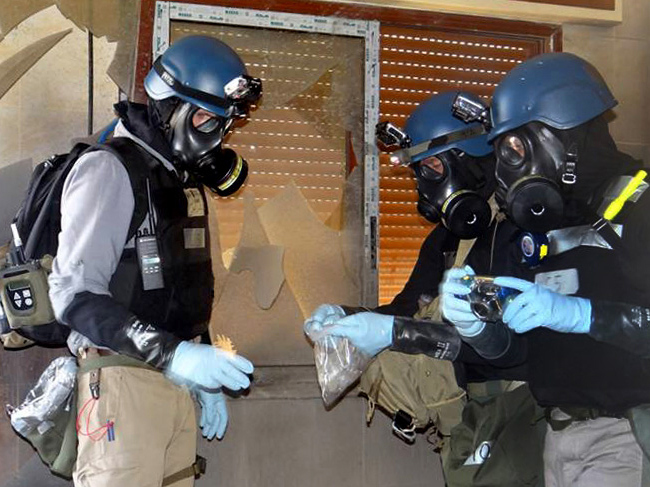
THE HAGUE, Netherlands (AP) — A spokesman for the global chemical weapons watchdog says destroying Syria’s stockpile of poison gas and nerve agents at sea is a possible alternative to finding a country willing to host the destruction.
The Organization for the Prohibition of Chemical Weapons aims to destroy some 1,300 metric tons of Syrian toxic agents by mid-2014, but the plan was dealt a blow last week when Albania rejected a U.S. request to host destruction. Authorities in Belgium and Norway also have ruled their countries out as locations for the risky operation.
OPCW spokesman Christian Chartier said Wednesday the alternative of destruction at sea, on a boat or floating rig, is a “feasible” possibility.
Chartier told The Associated Press, “All options are on the table.” No further details have been released.
Among mobile systems that could be put on a ship and sent to sea is one owned by the U.S. Defense Department. The Field Deployable Hydrolysis System is a transportable neutralization system that uses water, other chemicals and heat to change chemical warfare materiel into compounds not usable as weapons.
Ralf Trapp, a French-based international chemical weapons disarmament consultant and scientist, said chemical weapons have been transported by ship to remote locations in the past, including by the U.S. to the Pacific island of Johnston Atoll for destruction. But Trapp said he knew of no prior use of a boat or floating platform for on-board destruction of the lethal substances on the scale that would be required to dispose of Syria’s stocks.
Trapp told the AP that using a sea-based facility would have numerous advantages, including the ability to position it far from populated areas. But he said there were many problems to be addressed beforehand, including restrictions in the U.N. Convention on the Law of Sea intended to protect the marine environment, and how to transport the highly toxic cargo so it presented a minimal risk for sailors, other maritime traffic and the oceans in general.
In case the chemical weapons are incinerated, Trapp said, experts would have to decide what to do with the liquid waste resulting from the use of water to quench and treat the gases generated as byproducts. “It needs to be assessed whether such saltwater streams can be released without negative effects on the maritime environment, or whether such waste streams need to be treated at sea or stored for subsequent treatment on land,” the disarmament consultant said.
In Brussels, NATO officials were being briefed Wednesday by representatives of the Organization for the Prohibition of Chemical Weapons on how the Syrian disarmament plan is proceeding.
—
Pauline Jelinek in Washington and John-Thor Dahlburg in Brussels contributed.